PHARMA 4.0
The Complete Guide to Pharma 4.0 in 2026: How Pharmaceutical Manufacturing Is Being Rewritten
Reimagining pharmaceutical manufacturing through intelligent automation, real-time visibility, AI, and Pharma 4.0 innovation.

The Complete Guide to Pharma 4.0 in 2026: How Pharmaceutical Manufacturing Is Being Rewritten
Somewhere in a pharmaceutical plant right now, an operator is filling out a paper batch record by hand.
Across the same facility, a quality reviewer is searching through binders to verify yesterday's cleaning logs.
Down the corridor, a production manager is asking the same question they've asked every Monday for the past five years: "Why is this batch still in quarantine?"
This is pharmaceutical manufacturing as most of us know it. Careful. Documented. Regulated. And quietly, painfully inefficient.
But something has shifted.
A growing number of pharma companies have stopped accepting this as "just how it is." They've started asking better questions. And in answering those questions, they've stumbled onto something the industry is now calling Pharma 4.0 — a complete reimagining of how medicines get made.
This guide is for everyone trying to understand what Pharma 4.0 actually means in 2026 — not as a buzzword, but as a practical, measurable transformation that's already reshaping the industry.
What Exactly Is Pharma 4.0?
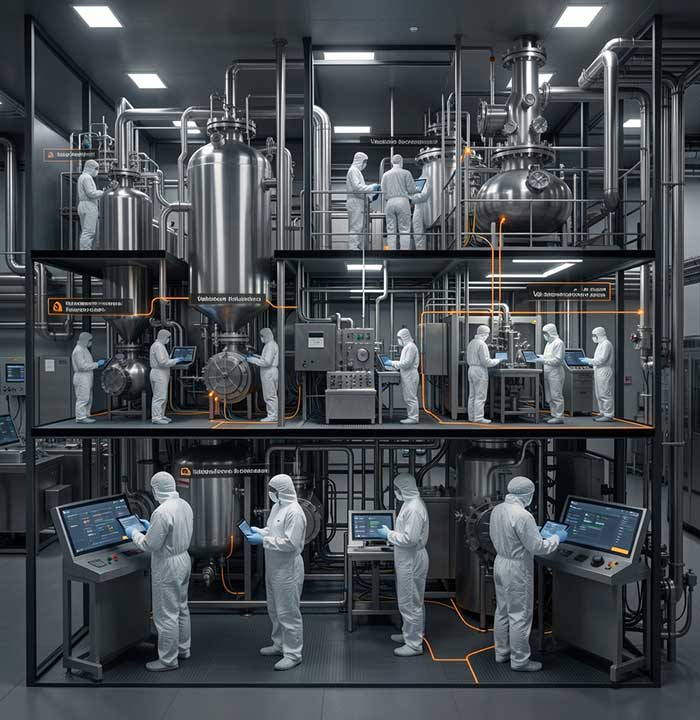
Pharma 4.0 is the pharmaceutical industry's version of Industry 4.0 — the global shift toward digital, connected, intelligent manufacturing.
But here's where it gets interesting.
Pharma can't simply copy-paste what automotive or electronics manufacturers have done. Why? Because in pharma, when something goes wrong, people don't get inconvenienced. People get hurt.
That's why Pharma 4.0 carries a heavier responsibility than its Industry 4.0 cousin. It must deliver all the benefits of digital transformation — speed, efficiency, intelligence — while honoring the non-negotiable demands of pharmaceutical manufacturing:
Regulatory compliance with FDA, EMA, MHRA, and WHO
Data integrity that holds up under scrutiny
Good Manufacturing Practice standards built into every workflow
21 CFR Part 11 compliance for every digital touchpoint
Patient safety as the unshakeable foundation
Think of Pharma 4.0 not as "pharma becoming tech," but as "pharma becoming intelligent" — without compromising what makes pharmaceutical manufacturing essential.
Why Pharma 4.0 Has Become Impossible to Ignore
For years, digital transformation in pharma moved at a measured pace. Slow. Deliberate. Often defensive.
Then 2026 happened.
Here's what changed — and why every pharmaceutical manufacturer is now thinking about Pharma 4.0:
The Audit Conversation Has Flipped
Walk into a regulatory audit today, and the question isn't "Why did you go digital?"
It's "Why are you still on paper?"
The FDA's Computer Software Assurance framework has matured. EU GMP Annex 11 expectations have hardened. Regulatory agencies worldwide now treat digital maturity as the expected baseline — not the exception.
If your competitors have automated audit trails and your team is still flipping through binders, the gap is no longer invisible.
The Cost of Manual Is Finally Visible
For decades, pharma absorbed the cost of manual processes as "just the cost of doing business."
In 2026, that math doesn't work anymore.
Consider what manual batch record management actually costs a mid-sized plant annually:
Cost Category | Annual Impact |
|---|---|
Batch release delays (12+ days extra per batch) | $2-5 million in delayed revenue |
Documentation error remediation (CAPAs) | $2-5 million in delayed revenue |
QA team time on paper review (vs. quality improvement) | 60% of QA capacity wasted |
Audit preparation (per major inspection) | 500+ person-hours |
Storage, retrieval, and physical infrastructure | $50,000-$150,000 |
Compliance risk premium (incident insurance) | Variable, increasing |
These numbers were always there. The difference now is that pharma executives are finally calculating them — and the case for transformation has stopped being theoretical.
Patient Demand Has Accelerated
Patients in 2026 expect medicines to be available, affordable, and consistent. Supply chain disruptions during the early 2020s taught the industry that paper-based, disconnected systems can't respond fast enough when the world demands speed.
Pharma 4.0 isn't just an internal efficiency play. It's a public health imperative.
The Five Pillars of Pharma 4.0 (And What They Actually Look Like)
Every conversation about Pharma 4.0 eventually circles back to the same five pillars. Here's what each one means in practice — stripped of jargon, grounded in reality.
Pillar 1: Paperless Operations
The most visible transformation. The most immediately profitable.
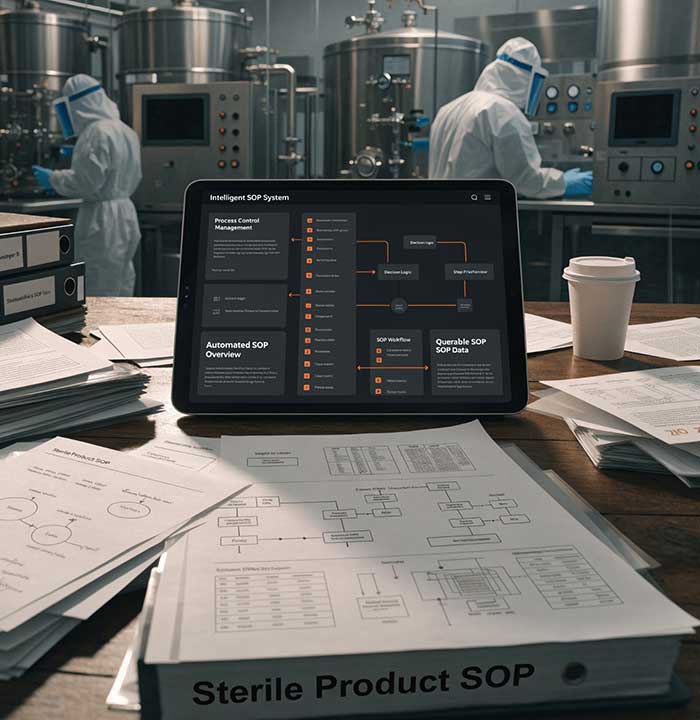
Pharmaceutical manufacturing generates enormous volumes of documentation: batch records, cleaning logs, equipment logbooks, SOP acknowledgments, deviation reports, change controls. In a traditional plant, most of this is paper.
In a Pharma 4.0 plant, all of it is digital:
Electronic Batch Manufacturing Records (eBMR) capture data in real-time as production happens
Digital eLogbooks replace paper binders with timestamped, searchable entries
Electronic SOPs ensure operators always have the current version
Digital quality records flow into integrated systems for instant retrieval
The result isn't just "less paper." It's a complete transformation in how quickly information moves through the organization. Batch release times drop from 15 days to 3. Audit preparation drops from weeks to days. The QA team stops being archaeologists and starts being quality strategists.
Pillar 2: Augmented Reality on the Shop Floor
If paperless is the most visible transformation, AR is the most surprising.
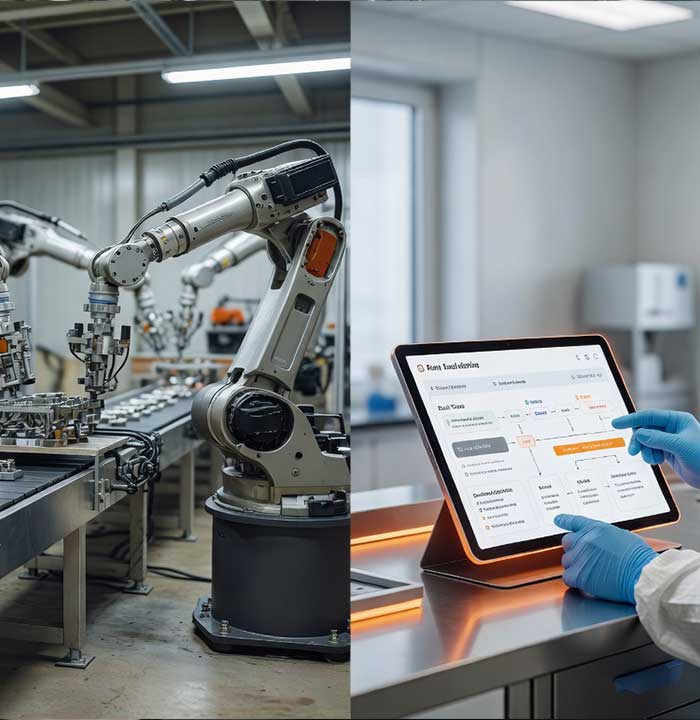
A pharma operator wearing AR glasses sees their work differently. Instructions appear directly on the equipment they're working with. Each step is visually highlighted. Validation checkpoints confirm correct execution. Expert support is one tap away.
The numbers from AR implementations in pharmaceutical manufacturing are striking:
60% reduction in operator training time
99.8% SOP compliance rate on guided procedures
Near-zero critical deviations during AR-assisted operations
Complete documentation generated automatically as work happens
For an industry where a single missed SOP step can become a deviation, then a CAPA, then an audit finding, the precision AR brings to the shop floor isn't a luxury — it's a fundamental change in how reliable operations can be.
Pillar 3: Artificial Intelligence Integrated Into Quality
For years, AI in pharma quality felt like a conference topic — interesting in theory, distant in practice.
That's no longer true.
In 2026, AI is performing real work in real pharmaceutical operations:
Document verification AI scans batch records and quality documents for inconsistencies in seconds — work that used to take human reviewers hours
Anomaly detection algorithms identify subtle patterns in process data that suggest potential deviations before they happen
Automated APQR generation aggregates data from multiple sources for Annual Product Quality Reviews, reducing preparation time from months to weeks
Intelligent OOS investigation helps QA teams quickly identify likely root causes by analyzing similar historical events
AI doesn't replace pharmaceutical expertise. It amplifies it. The best QA professionals in 2026 aren't competing with AI — they're using it as the most efficient research assistant they've ever had.
Pillar 4: Connected Equipment and Real-Time Visibility
The traditional pharma plant runs on a delay.
Equipment data sits in equipment until someone records it. Logbook entries get filled in at the end of a shift. Production metrics get reported in weekly meetings. Problems are discovered after they've already happened.
A Pharma 4.0 plant runs in real-time.
Industrial IoT sensors continuously monitor equipment performance, environmental conditions, and process parameters. Connected systems automatically capture data without manual transcription. Dashboards show production status, quality metrics, and equipment health as they evolve.
When a freezer drifts out of specification at 2 AM, the system knows immediately. When a tablet press shows early signs of mechanical fatigue, predictive maintenance kicks in before a failure happens. When a batch's data trends suggest a potential issue, alerts fire before the deviation occurs.
This shift — from reactive to predictive — is one of the most fundamental changes Pharma 4.0 enables.
Pillar 5: Data Integrity by Architecture
Of all five pillars, this one might be the most important.
For decades, pharmaceutical companies have approached data integrity as something to be audited — checked after the fact, corrected when gaps appeared, defended when regulators questioned it.
Pharma 4.0 flips this entirely.
In a digitally mature pharmaceutical environment, data integrity isn't audited. It's architected. The ALCOA+ principles (Attributable, Legible, Contemporaneous, Original, Accurate, plus Complete, Consistent, Enduring, Available) are built directly into how systems capture, store, and report data.
When data integrity is automatic:
Audit trails generate themselves
Timestamps come from validated system clocks, not human memory
User attribution happens at login, not in retrospective documentation
Tampering becomes technically impossible, not just procedurally discouraged
The 70% of FDA Warning Letters that cite data integrity failures? Almost all of them describe situations that simply cannot occur in well-designed digital systems.
The Real ROI of Pharma 4.0
The conversation about Pharma 4.0 often gets stuck on cost. "How much will this investment cost?"
The better question is: "What is the cost of not making this investment?"
Pharmaceutical companies that have implemented Pharma 4.0 solutions consistently report measurable returns:
Metric | Improvement |
Batch record review time | 40–60% reduction |
Documentation errors | 70–80% reduction |
Operator training time | 50–70% reduction |
Audit preparation time | 30–50% improvement |
Overall Equipment Effectiveness | 20–35% improvement |
The typical Pharma 4.0 investment breaks even within 12-18 months. Beyond that, it generates compounding value year after year.
The Practical Roadmap: How Pharma 4.0 Actually Gets Implemented
Pharma 4.0 isn't a single project. It's not something you buy on a Monday and have running by Friday.
But it's also not the multi-year mega-project that consulting firms sometimes describe. The pharmaceutical companies succeeding at digital transformation in 2026 follow a clear pattern:
Phase 1: Foundation (Months 1-3)
Goal: Eliminate paper from the highest-pain processes first.
Start with batch records (eBMR) or logbooks (eLogbook). These deliver immediate, measurable wins. They demonstrate value quickly. They build organizational confidence for what comes next.
A pilot on a single production line or product is often the right starting point. Prove the concept. Quantify the improvement. Then scale.
Phase 2: Integration (Months 3-9)
Goal: Connect systems and enable real-time visibility.
This is where IoT sensors, integrated quality systems, and connected equipment come together. AR-assisted training and SOP execution often enter the picture here. The plant starts feeling different — more responsive, more transparent, more in control.
Phase 3: Intelligence (Months 9-12)
Goal: Layer in AI and predictive capabilities.
With foundational data flowing reliably, AI applications become possible. Automated document review. Predictive quality. Intelligent APQR generation. The plant starts not just running faster, but running smarter.
Phase 4: Optimization (Ongoing)
Goal: Continuous improvement through data.
Once Pharma 4.0 foundations are in place, every operation becomes a source of insight. Trends become visible. Improvements compound. The organization develops genuine digital maturity — not as a project, but as a way of operating.
What's Stopping Pharma 4.0 Adoption (And Why Those Reasons Are Weaker Than They Seem)
Every pharmaceutical company considering Pharma 4.0 eventually encounters the same set of concerns. Let's address them honestly.
"We're worried about regulatory acceptance"
In 2026, this concern is largely behind us. FDA, EMA, and other major agencies actively encourage digital adoption. The frameworks for validation (CSV, CSA) are mature. The expectations are clearer than they've ever been.
The real regulatory risk in 2026 isn't being digital. It's continuing to use systems that can't meet modern data integrity expectations.
"Our operators will resist new technology"
This concern is more legitimate, but also more solvable than most leaders assume.
Resistance usually comes from one of two sources: fear of being replaced, or frustration with poorly-designed technology. Both are addressable.
When new systems are intuitive (AR-guided interfaces), when operators are involved in the design, and when the early wins are visible to the people doing the work, adoption follows quickly. The pharmaceutical operators of 2026 want better tools. They've been waiting for them.
"We can't justify the budget"
This is usually a calculation problem, not a budget problem.
Most companies calculate the cost of Pharma 4.0 investment but not the cost of continuing without it. When the full cost — delayed batches, CAPAs, audit findings, opportunity cost — is included, the math changes dramatically.
Pharma 4.0 isn't an expense. It's a profitable investment with a clear payback period.
"Our legacy systems are too entrenched"
Modern Pharma 4.0 platforms are designed to integrate with existing infrastructure, not replace it. APIs, middleware, and validated integration approaches make it possible to modernize gradually without disrupting operations.
The legacy system isn't the barrier most people think it is. The barrier is the assumption that everything must change at once.
The Companies Winning at Pharma 4.0 in 2026
The pharmaceutical manufacturers leading in 2026 share certain characteristics:
They started with a single high-impact process and expanded from there
They chose technology partners who understand pharma, not just software
They built compliance into their digital systems from day one
They involved operators in implementation, not just executives
They measured impact relentlessly and shared wins broadly
They treated transformation as continuous, not as a project with an end date
These companies aren't just running better today. They're positioning themselves for an industry future where digital maturity is the price of admission, not a competitive advantage.
The Question Every Pharmaceutical Leader Should Be Asking
For most of the past decade, the question about Pharma 4.0 was "When?"
In 2026, the question has changed.
It's now: "How quickly can we get there?"
Because the companies that move first are gaining capabilities, market position, and competitive advantages that compound year over year. The companies that wait are watching that gap widen.
Pharma 4.0 isn't coming. It's here.
The only remaining decision is whether your organization will lead the transformation or be reshaped by it.
Where to Start
If you're early in your Pharma 4.0 journey, the most important first step is also the simplest:
Identify your most painful manual process and solve it digitally.
For most pharmaceutical manufacturers, that's batch records. For some, it's logbooks. For others, it's SOP management or quality investigations.
Wherever it is, that's where to start. Prove the value. Build the case. Expand from there.
You don't need a perfect strategy. You need a focused first step and a partner who can help you take it.
Arizon Systems partners with pharmaceutical manufacturers worldwide to design and implement Pharma 4.0 solutions. From eBMR and eLogbooks to AR-assisted operations and AI-powered quality systems, every solution we build is purpose-designed for pharmaceutical environments — with GMP compliance, 21 CFR Part 11 adherence, and measurable operational impact built into the architecture.
Ready to transform your Pharma 4.0 journey?

Insights & Article