SOP INTELLIGENCE
From Binders to Brains: How SOP Intelligence Is Creating a New Category in Pharma Manufacturing
SOPs are the backbone of pharmaceutical manufacturing — yet they remain static, disconnected, and largely ignored during actual execution. Discover how SOP Intelligence is transforming documents into decision systems.
Introduction
Every pharmaceutical company in the world runs on SOPs.
Standard Operating Procedures are the backbone of GMP compliance. They define how every process should be executed. They ensure consistency. They satisfy regulators. They protect patients.
And they are, almost universally, ignored during actual execution.
Not intentionally. Not maliciously. Simply because a 40-page PDF is not a useful tool when you're standing in front of a reactor vessel trying to execute a critical process step under time pressure.
This is the SOP paradox:
The documents that define how work should be done have almost no influence on how work is actually done.
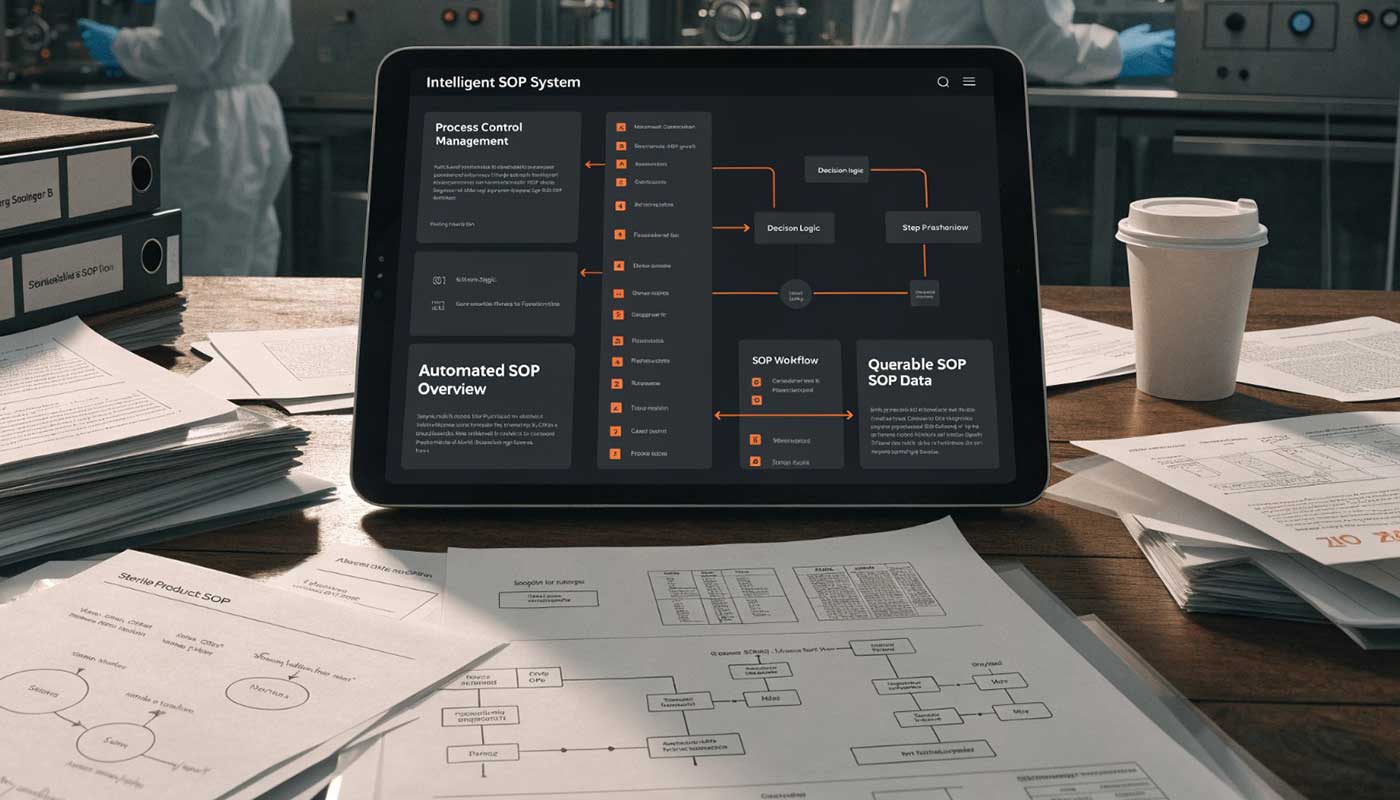
Operators rely on memory. On experience. On asking the person next to them. On habits formed during their first few months on the job. The SOP sits in a binder on a shelf — or in a document management system that requires 6 clicks to access — while the actual execution happens through interpretation, approximation, and institutional knowledge.
This article explores why this paradox exists, why it matters more than most organizations realize, and how a new category — SOP Intelligence — is fundamentally changing the relationship between documented knowledge and shop floor execution.
The Current State of SOPs in Pharma
Let's be honest about how SOPs actually function in most pharmaceutical manufacturing environments today:
1. SOPs Are Written for Regulators, Not Operators
Most SOPs are authored to satisfy regulatory requirements. They're comprehensive, precise, and legally defensible. They're also written in formal language, structured for document control, and designed to demonstrate compliance — not to guide execution.
An operator trying to quickly find the answer to "What do I do if the pressure reading exceeds the threshold during step 4b?" will likely find themselves scrolling through pages of purpose statements, scope definitions, and revision histories before reaching anything actionable.
2. SOPs Are Static in a Dynamic Environment
Manufacturing environments change constantly. Equipment is upgraded. Processes are optimized. Regulatory guidance evolves. But SOPs update on a cycle — often quarterly or annually. The gap between what the SOP says and what current best practice actually is can be significant.
More importantly, SOPs don't adapt to context. The same SOP is presented whether you're an experienced operator or a day-one trainee. Whether you're running a standard batch or handling an exception. Whether the equipment is the one specified in the SOP or a qualified alternative.
3. SOPs Are Disconnected from Execution
This is the fundamental problem. SOPs exist in document management systems. Execution happens on the shop floor. These two worlds rarely intersect in real time.
When an operator has a question during execution, the typical journey is:
Stop work
Find a computer terminal
Log into the DMS
Search for the relevant SOP
Find the correct version
Navigate to the relevant section
Interpret the instruction
Return to the shop floor
Execute (hopefully correctly)
This process takes minutes — sometimes longer. In practice, most operators skip it entirely and rely on memory or ask a colleague.
4. SOP Knowledge Is Trapped
Organizations invest thousands of hours creating, reviewing, and approving SOPs. This represents an enormous repository of institutional knowledge — process understanding, safety protocols, quality requirements, troubleshooting procedures, regulatory expectations.
But this knowledge is trapped in documents. It can't be queried. It can't be accessed contextually. It can't be analyzed for patterns or gaps. It can't adapt to the specific situation an operator is facing right now.
The most valuable knowledge in your organization is locked in the least accessible format.
Why This Matters More Than You Think
The SOP disconnection problem isn't just an inconvenience. It's a structural risk that compounds across every shift, every operator, and every site.
Impact 1: Execution Variability
When 50 operators across 3 shifts interpret the same SOP differently, you get 50 variations of what should be a standardized process. Some variations are minor. Some are not. The problem is that you often can't tell the difference until a deviation occurs.
Impact 2: Training Dependency
Without intelligent SOP access, training becomes the primary mechanism for transferring procedural knowledge. This creates a bottleneck: new operators take months to become fully productive, experienced operators become irreplaceable knowledge holders, and knowledge transfer is always incomplete.
Impact 3: Compliance Gaps
If operators aren't actively consulting SOPs during execution, there's no real-time assurance that procedures are being followed correctly. Compliance becomes an assumption — validated only through post-execution documentation review, which itself depends on accurate manual recording.
Impact 4: Slow Decision-Making
When a non-standard situation arises during production — an unexpected reading, an equipment alert, a process anomaly — the operator needs to make a decision. The right answer is almost certainly documented somewhere in the SOP library. But accessing it quickly, in context, under pressure? That's where the system fails.
What Is SOP Intelligence?
SOP Intelligence is a new category of technology that transforms SOPs from static documents into dynamic, queryable, context-aware knowledge systems.
It doesn't just digitize SOPs. It doesn't just put them on a tablet. It fundamentally changes what an SOP is — from a document you read to a system you interact with.
Core Capabilities of an SOP Intelligence Platform:
1. Natural Language Querying
Operators can ask questions in plain language:
"What is the acceptable pressure range for reactor vessel B during the granulation phase?"
"What should I do if the temperature reading exceeds 85°C during step 7?"
"What PPE is required for handling Material X?"
The system understands the question, identifies the relevant SOP(s), locates the specific answer, and delivers it — in seconds, in context, without the operator ever leaving the shop floor.
2. Context-Aware Delivery
The system knows:
Who is asking (role, competency level, authorization)
What they're doing (current task, current step, current batch)
Where they are (which equipment, which area, which site)
When they're asking (phase of operation, shift, time-sensitive context)
Based on this context, the system delivers not just the right SOP — but the right section, the right step, and the right level of detail.
An experienced operator gets a concise confirmation. A trainee gets detailed step-by-step guidance. Automatically.
3. Compliance Intelligence
The platform doesn't just serve information — it validates it. It can:
Identify missing procedural steps before they become deviations
Flag SOP sections that conflict with current regulatory guidance
Ensure that the operator has completed all required prerequisites
Verify that the correct SOP version is being followed
Compliance isn't checked after execution. It's embedded in the knowledge delivery itself.
4. Semantic Understanding
Unlike simple search or keyword matching, SOP Intelligence uses AI to semantically understand the content of SOPs. It builds knowledge graphs that connect related concepts, procedures, materials, equipment, and regulatory requirements.
This means it can answer questions that span multiple SOPs, identify relationships between procedures, and surface relevant information that a simple search would never find.
5. Continuous Learning
The system learns from every interaction. Which questions are asked most frequently? Where do operators struggle? Which SOPs generate the most queries? Which steps have the highest error rates?
This data feeds back into SOP authoring, training programs, and process improvement — creating a continuous loop of knowledge optimization.
SOP Intelligence vs. Traditional SOP Management
Aspect | Traditional SOP Management | SOP Intelligence |
Format | Static documents (PDF, Word) | Dynamic, interactive knowledge system |
Access | Search → Find → Read → Interpret | Ask → Receive → Execute |
Context | One version for everyone | Adapted to role, task, equipment, and situation |
Compliance | Checked after execution | Embedded in knowledge delivery |
Learning | None — documents don't learn | Continuously improves from every interaction |
Speed | Minutes to find relevant information | Seconds to receive precise answers |
Knowledge Utilization | Fraction of SOP content is ever accessed | Full knowledge base is actively utilized |
Integration | Standalone in DMS | Connected to execution workflows |
Why This Is a New Category, Not a Feature
SOP Intelligence isn't a feature you add to your existing document management system. It's a fundamentally different approach to how procedural knowledge functions within an organization.
Here's why it constitutes a new category:
1. It Changes the Unit of Knowledge
Traditional systems manage documents. SOP Intelligence manages knowledge. The difference is profound. A document is a container. Knowledge is understanding. When you manage documents, you manage files and versions. When you manage knowledge, you manage meaning, context, and applicability.
2. It Changes the Interaction Model
Traditional systems require users to find information. SOP Intelligence delivers information. The user doesn't navigate a document hierarchy or execute a search query. They ask a question — or the system proactively delivers guidance based on what they're doing.
3. It Changes the Value of SOPs
In traditional systems, SOPs are a compliance cost — they must be written, reviewed, approved, trained on, and maintained. In SOP Intelligence, SOPs become a strategic asset — an intelligent knowledge base that actively improves execution, reduces errors, accelerates training, and prevents deviations.
The ROI model flips. SOPs go from a cost of compliance to a driver of operational excellence.
4. It Changes the Role of Training
When operators have instant, context-aware access to procedural knowledge, the role of training shifts. Training no longer needs to transfer every piece of procedural knowledge into every operator's memory. Instead, training focuses on building judgment, understanding principles, and developing competency — while the SOP Intelligence system handles procedural guidance.
This dramatically reduces time-to-competency and eliminates the impossible expectation that every operator memorizes every procedure perfectly.
Real-World Applications
Let's make this concrete with scenarios that every pharma manufacturing professional will recognize:
Scenario 1: The New Operator
Traditional approach: A new operator completes 4 weeks of classroom training, reads 200+ pages of SOPs, shadows an experienced operator for 2 weeks, and is gradually given independent responsibility. For months, they frequently ask colleagues for guidance, sometimes getting different answers from different people.
SOP Intelligence approach: The same operator completes focused competency training, then begins supervised execution with the SOP Intelligence system providing real-time, step-by-step guidance. Every instruction is consistent. Every question gets the same correct answer. Time-to-independent-operation drops dramatically.
Scenario 2: The Unexpected Deviation
Traditional approach: During a batch, an operator observes an unusual temperature excursion. They stop the process, find a supervisor, discuss the situation, locate the relevant SOP section, interpret the guidance, consult with QA, and eventually make a decision. Total time: 30-90 minutes. During which the batch is at risk.
SOP Intelligence approach: The operator asks: "Temperature in vessel 3 exceeded 78°C during mixing phase — what action should I take?" Within seconds, the system delivers the specific guidance from the relevant SOP, including acceptable ranges, required actions, documentation requirements, and escalation criteria.
Scenario 3: The Regulatory Audit
Traditional approach: An auditor asks: "Can you show me the procedure for cleaning equipment X after processing Material Y, and demonstrate that all operators are trained on the current version?" Your quality team scrambles through the DMS, training records, and execution logs — often taking hours to compile a complete response.
SOP Intelligence approach: The system can instantly surface the relevant SOP, show all trained operators, display the current version status, and provide analytics on how frequently the procedure is accessed and followed. Audit response time: minutes.
The Strategic Implications
For pharmaceutical companies, SOP Intelligence isn't just an operational improvement. It has strategic implications across the organization:
For Manufacturing Leaders
Standardized execution across all sites and shifts
Reduced dependency on individual operator expertise
Faster scale-up of new products and processes
For Quality Leaders
Continuous compliance assurance
Proactive gap identification
Dramatically faster audit preparation and response
For Digital Transformation Leaders
A foundation for AI-driven manufacturing
A knowledge layer that connects execution, compliance, and analytics
A measurable, high-ROI digital investment
For the C-Suite
Reduced operational risk
Improved regulatory standing
Faster time-to-market for new products
A genuine competitive advantage
What to Look for in an SOP Intelligence Platform
If you're evaluating SOP Intelligence solutions, these capabilities are non-negotiable:
Capability | Why It Matters |
Natural language querying | Operators won't adopt anything that requires complex navigation |
Semantic understanding | Keyword search isn't intelligence — it's a better Ctrl+F |
Context awareness | Generic answers aren't enough — guidance must be specific to the situation |
Compliance integration | Knowledge delivery and compliance validation must be inseparable |
Execution layer connection | SOP Intelligence must connect to guided execution — not exist in isolation |
Continuous learning | The system must improve with every interaction |
Enterprise scalability | Must support multi-site, multi-language, multi-product environments |
The Bottom Line
The pharmaceutical industry has treated SOPs as a compliance necessity — documents to be written, reviewed, filed, and occasionally consulted.
SOP Intelligence transforms them into the most powerful operational asset in your organization.
When your SOPs can be queried in natural language, delivered in context, validated for compliance, and continuously improved through AI — they stop being documents and start being decision systems.
This isn't an incremental improvement to document management. It's a new category of technology that changes the relationship between knowledge and execution in regulated manufacturing.
The companies that adopt SOP Intelligence first won't just be more compliant. They'll be more efficient, more consistent, more resilient, and fundamentally more competitive.
The question isn't whether SOPs should become intelligent. The question is whether yours will — before your competitors' do.
About Arizon Systems
Arizon Systems' SOP Intelligence Platform is the industry's first system that transforms static SOPs into queryable, context-aware, compliance-validated knowledge systems. It's the core differentiator of our execution intelligence platform — and the capability that regulated manufacturers consistently identify as transformative.
Insights & Article