EXECUTION INTELLIGENCE
The Execution Gap: Why MES, ERP & QMS Can't Solve Manufacturing's Biggest Problem | Arizon Systems
Despite billions invested in MES, ERP, and QMS, execution in regulated manufacturing remains manual and inconsistent. Discover the missing layer — execution intelligence.

Introduction
Here's something that should trouble every manufacturing leader in regulated industries:
You've invested in MES. You've deployed ERP. You've implemented QMS. You've spent years digitizing, integrating, validating, and training.
And yet.
Your shop floor still runs on experience and instinct. Your SOPs still sit in binders — or in PDFs that nobody opens during actual production. Your execution quality still depends on which operator is on shift. And your compliance team still spends weeks scrambling before every audit.
This isn't a technology failure. It's an architecture failure.
The systems you've invested in were never designed to solve the problem that costs you the most: the execution gap.
This article explores what the execution gap actually is, why your current systems can't close it, and what a fundamentally different approach looks like.
The Three Layers of Manufacturing Technology
To understand the execution gap, you need to understand how manufacturing technology has evolved — and where it stopped evolving.
Layer 1: Automation (1970s–1990s)
The first wave brought machine-level control:
PLCs (Programmable Logic Controllers)
SCADA (Supervisory Control and Data Acquisition)
DCS (Distributed Control Systems)
These systems automated physical processes. Machines became faster, more precise, and more reliable.
What they solved: Machine control and process automation.
What they didn't solve: Anything involving human decision-making, procedural execution, or operational intelligence.
Layer 2: Digitization (2000s–2010s)
The second wave brought enterprise and manufacturing systems:
MES (Manufacturing Execution Systems)
ERP (Enterprise Resource Planning)
QMS / EQMS (Quality Management Systems)
LIMS (Laboratory Information Management Systems)
These systems digitized transactions, records, and workflows. They replaced paper with screens. They created audit trails. They managed resources.
What they solved: Data capture, transaction management, and record-keeping.
What they didn't solve: How operators actually execute tasks on the shop floor. How SOPs are interpreted. How compliance is maintained in real time. How decisions are made during production.
Layer 3: The Missing Layer — Execution Intelligence
This is where the gap exists.
Between your enterprise systems and your shop floor reality, there's a critical space that no system occupies:
Real-time execution guidance — telling operators exactly what to do, step by step, in context
Continuous compliance validation — verifying every action at the point of execution, not after
Context-aware knowledge delivery — making SOPs intelligent and accessible during operations
Decision intelligence — turning execution data into autonomous, predictive decisions
This is the execution gap.
And it's the most expensive problem in regulated manufacturing.
What the Execution Gap Actually Costs You
The execution gap isn't theoretical. It manifests in very real, very expensive ways:
1. Execution Variability
When 10 operators execute the same SOP, you get 10 different interpretations. Experienced operators compensate with institutional knowledge. New operators make mistakes that experienced operators would catch instinctively.
The result: Inconsistent product quality, unpredictable batch outcomes, and a hidden dependency on individual expertise that no training program can fully address.
2. Reactive Compliance
Your QMS tracks deviations — after they happen. Your audit preparation takes weeks — because compliance data is scattered across systems. Your quality team spends more time documenting compliance than ensuring it.
The result: Audit findings, warning letters, delayed batch releases, and a compliance posture that's always one step behind.
3. SOP Disconnection
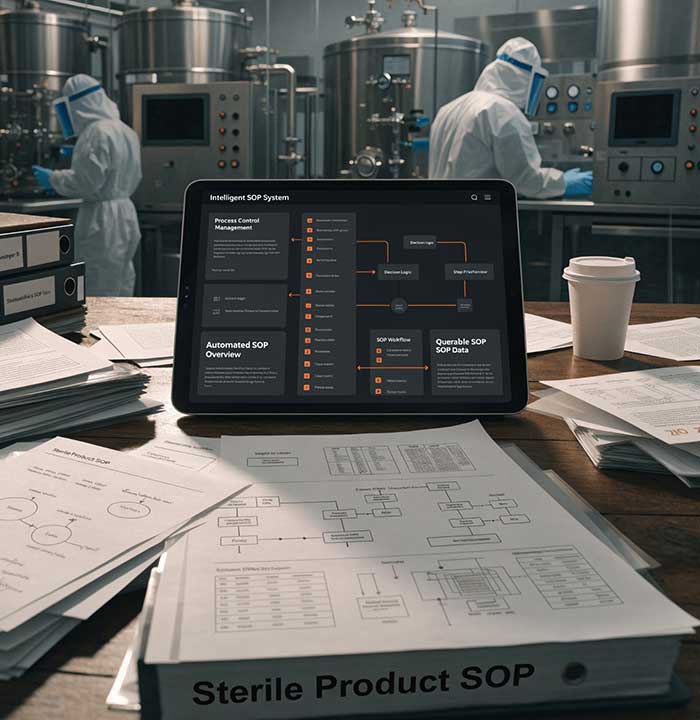
Your SOPs are comprehensive, well-written, and carefully reviewed. They're also effectively invisible during actual execution. Operators don't consult 40-page documents while running a batch. They rely on memory, habit, and peer guidance.
The result: The gap between what your SOPs say and what actually happens on the shop floor grows wider with every shift change, every new hire, and every process update.
4. Data Fragmentation
Your MES has execution data. Your ERP has planning data. Your QMS has quality data. Your LIMS has lab data. But none of these systems talk to each other in a way that produces actionable, real-time intelligence.
The result: Decisions are made on incomplete information. Patterns are missed. Predictions are impossible. And the data that could transform your operations sits in silos, generating reports that arrive too late to matter.
Why MES Can't Close the Gap
Let's be specific about why your existing systems — particularly MES — can't solve this problem.
MES was designed to manage manufacturing operations at the transaction level. It tracks orders, sequences operations, records production data, and provides visibility into what happened.
But MES doesn't:
MES Does | MES Does NOT |
Record that a step was completed | Guide the operator through the step |
Log production data | Validate actions in real time |
Track batch progress | Prevent errors at the point of execution |
Provide post-hoc reports | Deliver context-aware intelligence during operations |
Manage workflows | Convert SOPs into intelligent, interactive systems |
MES tells you what happened. It doesn't control what's happening.
That distinction is the execution gap.
Why ERP Can't Close the Gap
ERP operates at the enterprise level — planning resources, managing supply chains, handling financials. It's essential infrastructure. But it has zero visibility into how a specific operator is executing a specific SOP on a specific piece of equipment at this exact moment.
ERP plans the work. It doesn't guide the work.
Why QMS Can't Close the Gap
QMS manages quality processes — deviations, CAPAs, change controls, document management. It's critical for quality governance. But it operates retrospectively. It manages the consequences of execution failures. It doesn't prevent them.
QMS responds to quality problems. It doesn't eliminate them at the source.
The Architecture Problem
Here's the fundamental issue:
MES, ERP, and QMS were designed as independent systems solving independent problems. They were never architected to work together as a unified execution intelligence layer.
Even when they're integrated (which itself is a massive, multi-year effort), the integration is typically at the data level — sharing records, syncing transactions, exchanging batch information.
What's missing is intelligence-level integration:
Understanding what the operator needs to do right now
Knowing which SOP applies to this specific context
Validating compliance in real time, not retrospectively
Learning from execution patterns to predict and prevent failures
No amount of MES-ERP-QMS integration can produce this. Because the capability doesn't exist within any of these systems.
It requires a new layer.
What the Missing Layer Looks Like
The execution intelligence layer operates above MES, ERP, and QMS — not replacing them, but connecting and enhancing them.
Here's what it does:
1. Converts SOPs into Intelligent, Executable Systems
Instead of static documents, SOPs become queryable, context-aware intelligence systems. Operators can ask questions in natural language. The system delivers the right information for the right task at the right moment.
2. Guides Execution in Real Time
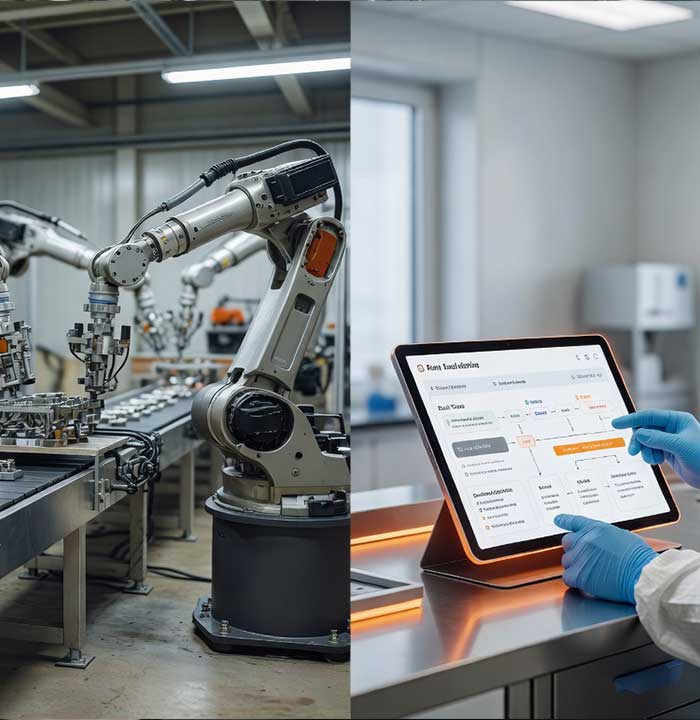
Every operation is guided step-by-step with visual instructions, AR overlays, and contextual prompts. Execution is standardized across every operator, every shift, every site — regardless of experience level.
3. Validates Compliance Continuously
Every action is validated at the point of execution. Mandatory checkpoints ensure nothing is skipped. Deviations are detected before they become audit findings. Compliance isn't prepared — it's embedded.
4. Transforms Data into Decision Intelligence
Execution data from every operation is captured, structured, and analyzed in real time. AI identifies patterns, predicts risks, and recommends optimizations. Over time, the system learns and improves autonomously.
5. Connects Everything
The execution intelligence layer integrates with your existing MES, ERP, QMS, and LIMS — pulling context from each system and pushing intelligence back. It doesn't replace your infrastructure. It makes your infrastructure intelligent.
The Shift: From Data Management to Execution Intelligence
Traditional Approach | Execution Intelligence Approach |
SOPs are documents | SOPs are intelligent systems |
Execution depends on operators | Execution is guided and validated |
Compliance is prepared for audits | Compliance is continuous and embedded |
Data is stored in silos | Data drives real-time decisions |
Quality is reactive | Quality is predictive |
Systems capture what happened | Systems control what's happening |
Who Needs This — and When
If you recognize any of these situations, the execution gap is actively costing you:
✅ Your batch release takes days or weeks because of documentation review
✅ Your audit preparation consumes your quality team for weeks
✅ Execution quality varies significantly between shifts or sites
✅ New operators take months to reach full productivity
✅ Your SOPs are comprehensive but largely ignored during actual production
✅ You have more data than ever, but fewer actionable insights
✅ Deviations keep recurring despite CAPA after CAPA
✅ You've invested heavily in MES/ERP/QMS but still feel blind to what's happening on the shop floor
The Bottom Line
The manufacturing industry has spent two decades investing in systems that manage data, transactions, and records. Those investments were necessary and valuable.
But they left the most critical layer untouched: execution.
The gap between what your systems know and what actually happens on the shop floor is where deviations are born, where compliance breaks down, where efficiency is lost, and where quality becomes unpredictable.
Closing this gap doesn't require better MES. It doesn't require more ERP modules. It doesn't require another QMS integration.
It requires a fundamentally new layer — an execution intelligence platform that sits above your existing systems and transforms how operations are actually performed.
The question isn't whether this layer is needed. The question is how long you can afford to operate without it.
About Arizon Systems
Arizon Systems is an AI-native execution intelligence platform for regulated industries. We transform how operations are performed, validated, and optimized — in real time. Our platform sits above existing MES, ERP, and QMS systems, connecting them into a unified intelligent execution environment.
Insights & Article